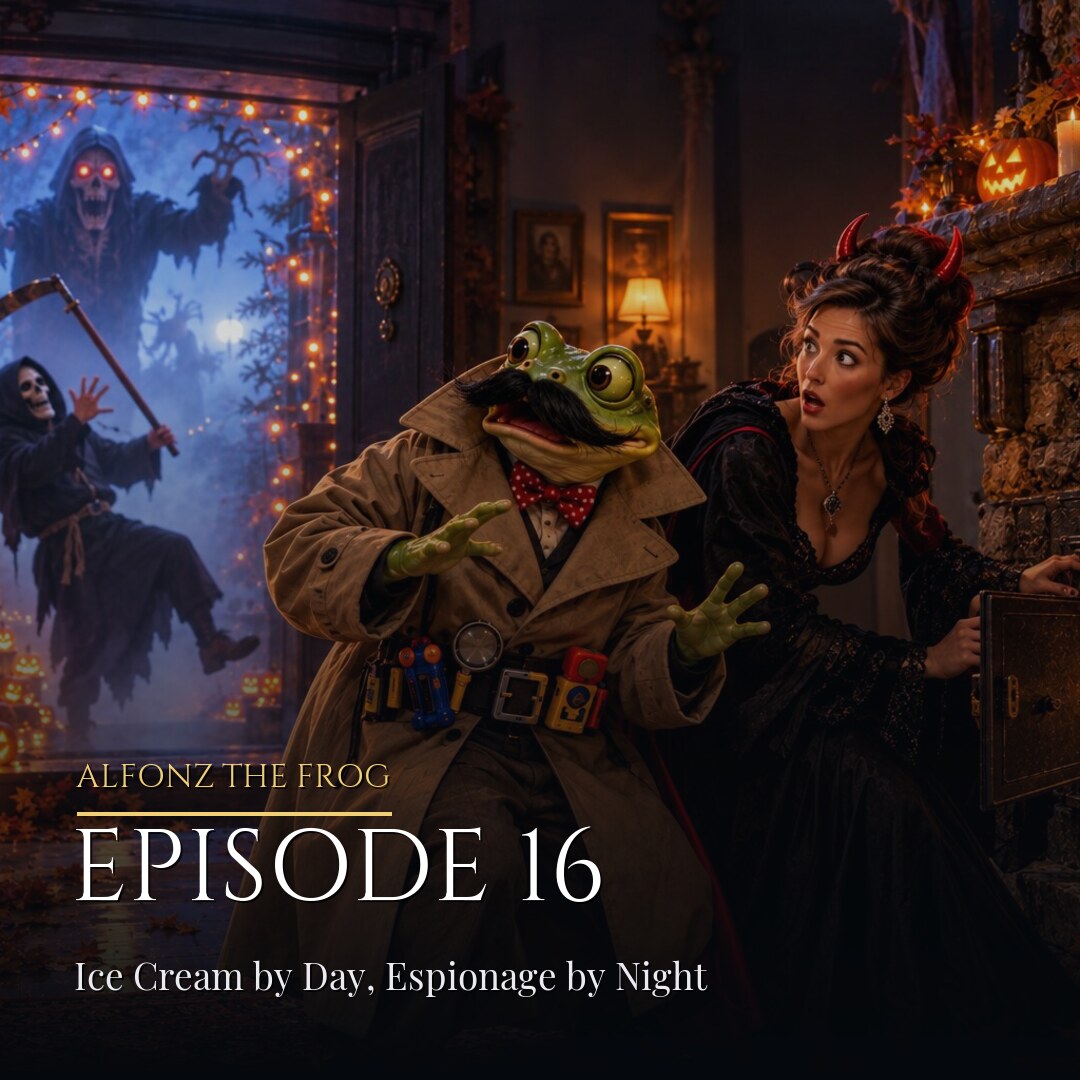
#16 · Cookies and Scream
October 29, 2026
Episode 16 — Cookies and Scream
At ten in the morning the sun over Riverside had gone that particular gold that only happens in late October, and Alfonz was cranking his tinny "Entertainer," and Emma Rodriguez was first at the window, the way she was always first.
"Two scoops of mint chip," she announced, "and I need to know if you're doing a special flavor for the Harvest Haunt tonight."
"I am debuting," Alfonz said, with the gravity of a man announcing a state secret, "a cinnamon spice cookie sandwich. It is either a triumph or a disaster. I will know by nine o'clock."
"What's it based on?"
"An old recipe. Very old. I found half of it and am guessing at the rest." He handed down her cone, the second scoop wobbling just so, and did not mention that the recipe in question belonged to a dead man the whole town still told stories about, because some things are more fun to discover at a festival than explained at a service window.
"Mrs. Fenwick says the haunted house is in the real Crane house this year," Emma reported, delighted and a little afraid of her own delight. "She says he hid a fortune in there and nobody ever found it and maybe you'll find it, because you find everything."
"I find ice cream," Alfonz said. "That is the whole of my expertise."
She did not believe him even slightly, and ran off across the grass to tell someone else the same rumor, and Alfonz — who had, admittedly, spent the last three days quietly charmed by a dead man's handwriting — decided he would allow himself exactly one evening of being an ordinary, curious neighbor, and nothing more.
Mrs. Fenwick told the story the way she told everything, to the whole street at once, and by evening Alfonz had heard four versions and believed roughly none of them and enjoyed all four immensely.
Barnabus Crane had lived alone in the big gray house at the end of Chestnut for forty years, kept his shutters closed, grew nothing, spoke to no one, and was — by unanimous neighborhood consensus, none of it evidenced — sitting on a fortune he'd never spent and never would. When he died, the searches had been thorough and had found nothing but an empty house, a locked recipe box, and a single yellowed card behind glass that the historical society had framed and hung in the front hall because it was, at least, something.
"A miser and a mystery," Mrs. Fenwick said with relish, arranging plastic skeletons on her porch rail. "That house has been sitting there judging us for thirty years. About time somebody scared themselves silly in it on purpose."
Riverside's Harvest Haunt filled Chestnut Street end to end by seven — hay bales, string lights, a cider stand, forty children in costumes ranging from ambitious to structurally unsound — and at the center of it all, floodlit and fog-machined into something genuinely unsettling, stood the Crane house, transformed for one night into the town's haunted walkthrough.
Alfonz worked his stand in full costume, because a man ought to commit: a trench coat two sizes too dramatic, a mustache applied with more enthusiasm than skill, and a plastic gadget belt that jingled when he moved. He had told three separate customers, cheerfully, that he was a secret agent tonight, and all three had laughed, because the actual truth is the safest lie a man can ever tell on a night when everyone is pretending to be something else.
"Nice mustache," said a voice behind him, low and amused, and every muscle in Alfonz's body went instantly, thoroughly still.
He turned. A woman in an elegant black gown, horns worked subtly into an elaborate updo, stood examining his cookie sandwiches with the polite interest of a customer who had absolutely no interest in cookies.
"You're a long way from your usual work," Alfonz said quietly.
"I'm on vacation," Scorpia said. "One hears things, even on vacation. An old miser, a fortune nobody found, a house full of strangers wandering around in the dark tonight with perfect cover to look anywhere they like." She tilted her head, taking in the mustache properly. "I confess I did not expect the fortune to already have a costume."
"I am not here for a fortune. I am here for cookies."
"Of course you are." She smiled, and it was the old wattage, warmer than it used to be. "Save me a scoop, little frog. I intend to look around."
He found the recipe card before he found Scorpia again, framed behind cracked glass in what had once been Crane's front hall and was now hung with cobwebs real and fake in roughly equal measure.
BARNABUS CRANE'S SPICED SNAPS 2 cups flour, sifted twice 1 cup dark molasses, poured slow A pinch of nutmeg, no more Step twice past the hearth before you mix Fold gently — three taps on the oven door Chill until the porch light dims Bake at 350°, no peeking
It read, at a glance, like an ordinary recipe written by an ordinary eccentric. Alfonz had spent three days believing exactly that, right up until tonight, standing in the actual house, in the actual front hall, with an actual hearth visible through the actual kitchen doorway, and understood all at once that a man does not write "step twice past the hearth" into a cookie recipe unless he means it literally.
"You found it too," said a new voice, dry and precise, and Alfonz turned to find a trim, silver-templed man in a cheap grim-reaper costume — black robe, hood shoved back off his face, a plastic scythe held loosely in one hand — studying the frame with far too much focus for a volunteer decorator.
"It's a nice piece of local history," Alfonz said mildly.
"It's a map," the man said, not even trying to disguise it, which told Alfonz everything he needed to know about how confident the man was that no one else in this town could possibly be listening properly. "Mortimer Vail. Antiques, mostly — and mostly, lately, Barnabus Crane. Thirty years nobody's read this thing as anything but a cookie recipe. Tonight, for one night, I finally have an excuse to be in every room of this house without anyone asking why." He tapped the glass, almost fond. "Step twice past the hearth. Three taps on the oven door. A man doesn't hide directions that plainly unless he's certain nobody's ever going to look properly."
"You could simply ask the historical society for a research visit."
"I have. Six times. They say the house isn't for sale and the recipe isn't for study, and would I like a pamphlet." Vail smiled thinly. "Tonight the whole town is wandering through with permission and a flashlight. I intend to be one of them, doing exactly what I came to do, and not one soul will think twice."
He walked off toward the kitchen, unhurried, and Alfonz thought, not for the first time this year, that everyone in his life eventually turned out to have a plan hiding inside an ordinary excuse.
He caught up with Scorpia in the kitchen doorway, both of them arriving at once at the sight of the actual hearth — cold, swept, decorated for the night with a plastic cauldron and a string of orange lights — and the actual oven, an ancient cast-iron thing nobody had used in thirty years, its door hanging slightly open on a broken hinge.
"Step twice past the hearth," Scorpia murmured, reading over his shoulder without asking permission, which was, he reflected, entirely in character. "That's a direction, not a distance."
"North, presumably, if he was standing at the hearth facing the room." Alfonz walked it — one step, two — and found himself precisely at the edge of the old oven, close enough to touch the door. "And this is the oven door he means. Not folding batter at all."
"Three taps," Scorpia said, and rapped her knuckled ring against the cast iron three times, unceremonious, and something behind the oven's warped inner panel shifted with a small, dusty click.
They both went very still.
"Chill until the porch light dims," Alfonz said slowly, working it through. "The porch light is on a timer. It dims at nine exactly — I saw it flicker when I arrived."
Scorpia checked a slim watch at her wrist. "Four minutes."
Behind them, in the front hall, Mortimer Vail's unhurried footsteps had stopped being unhurried.
What followed took four minutes and felt considerably longer.
Vail arrived at a near-run, all pretense of casual interest abandoned, and found Alfonz and Scorpia already crouched at the oven with the exact air of two people who had gotten there first — which, technically, they had, though neither had yet actually opened anything.
"That's mine," Vail said, with the particular fury of a man who has waited years for something and can see it six feet away. "Thirty years I have wanted into this house—"
"It is not, strictly speaking, anybody's," Alfonz said, "until we know what it is."
The porch light, precisely on schedule, dimmed.
The oven's inner panel — rusted, warped, exactly loose enough — swung inward with a groan, and behind it, in a cavity no bigger than a shoebox, sat a small tin cashbox and a leather-bound ledger, both furred with three decades of dust.
And at that exact moment, in the front parlor beyond the kitchen doorway, the Harvest Haunt's marquee scare — a seven-foot animatronic reaper, fog cannon, and a shriek loud enough to rattle the framed recipe on the wall — fired precisely on its scheduled cue.
Mortimer Vail, mid-lunge for the cashbox, screamed like a man discovering his own mortality — which seemed, under the circumstances, like a rather personal insult from one reaper to another — stumbled backward through the kitchen doorway, and landed flat in the front parlor directly in the path of an oncoming tour group of eleven trick-or-treaters and their extremely amused parents.
"HE'S NOT PART OF THE SHOW," announced an eight-year-old, delighted, pointing.
He was not, in fact, part of the show, and by the time he'd finished explaining — loudly, to an increasingly interested crowd — exactly why a grown man in a cut-rate grim-reaper costume, plastic scythe skidded halfway across the floor ahead of him, had been lunging into a wall cavity behind a haunted house's antique oven, several parents had already started filming, and the historical society's president had arrived to ask, with the flat calm of a woman who had been waiting thirty years for this exact conversation, precisely what Mr. Vail thought he was doing in her exhibit.
The cashbox held four hundred and twelve dollars in worn small bills, a stack of coins nobody had minted in decades, and a ledger that turned out to be the actual treasure, once anyone had the patience to read it: forty years of careful, tiny handwriting, tracking every string of lights, every hay bale, every bag of candy the town's Halloween festival had ever needed and never quite been able to afford — all of it paid for, anonymously, year after year, by the miser at the end of Chestnut Street who never once let anyone thank him for it.
"He wasn't hiding a fortune," the historical society's president said, reading it aloud to a hushed knot of neighbors on the porch, her voice gone thick. "He was funding us. All this time. The whole festival."
Scorpia, beside Alfonz on the porch steps, exhaled something that was almost a laugh.
"Four hundred dollars," she said. "I came out on a work night for four hundred dollars and a dead man's grocery ledger."
"You could have taken it."
"I could have." She watched the president fold the ledger against her chest like something precious. "I find I don't want to, which is a very inconvenient thing to discover about oneself at my age." She stood, brushing off her gown, horns catching the string lights. "Save me a scoop next time, little frog. A real one. I find sentiment works up an appetite."
She was gone into the crowd before he could answer, the way she always was, and Alfonz did not try to follow.
They named the cashbox's contents the Crane Fund on the spot, right there on the porch, and voted — unanimously, loudly, by show of hands — to put it toward next year's festival, doubled by whatever the town could add to it. Mortimer Vail left in the back of a patrol car looking, by all accounts, considerably less dignified than a grim reaper has any business looking, his scythe confiscated as evidence of nothing in particular.
Alfonz sold out of cinnamon spice cookie sandwiches by nine-thirty, gave the last one to Emma for free, and told her, when she asked what he'd been doing near the Crane house all evening, that he had simply been curious about an old recipe.
"Did you find the rest of it?" she asked, sticky and delighted, already halfway to the next thing.
"I found," Alfonz said, "that it was never really about the recipe."
She had no idea what he meant, which was exactly right, and she ran off into the last of the string lights and the last of the screaming, laughing children, and Alfonz stood a moment on the porch of a dead man's house, in a costume that told the exact truth to no one, and thought that some treasures were only ever meant to be found by the people who stopped looking for them selfishly.
Behind him, the recipe card hung a little crooked in its frame, and someone had already started planning, in loud and cheerful voices, exactly how big next year's Harvest Haunt was going to be.
« All episodes