#8 · Rocky Road
September 3, 2026
At ten in the morning the sun over Riverside was an easy gold, and Alfonz was cranking his tinny "Entertainer," and Emma Rodriguez was first at the window, the way she was always first.
"Two scoops of mint chip," she announced. "And you look happy today."
"I am always happy, chérie." He built the cone, the second scoop wobbling just so. "It is a requirement of the job."
"Mrs. Fenwick says you finally learned to relax."
"Mrs. Fenwick is a national treasure," said Alfonz, and handed the cone down, and meant every word of it.
She ran off across the grass, and his earpiece came alive, low and dry.
"Ribbit-7. Morning report first. The route's quiet. Our patient friend in the cold room hasn't moved a muscle in three weeks — no money, no proof, no thread he can pull that goes anywhere." Handler let that sit a half-second, then set it down for good. "Which means, for once, I have something almost pleasant for you."
"I don't believe you."
"You will hate that you enjoy it. This one isn't Nightshade. It isn't a weapon, it isn't a market, it isn't the end of anything." He could hear her almost smiling. "It's a jewel."
She told him about the Sazerac — a cognac-colored diamond the size of a robin's egg, warm as a lit match, currently riding a very expensive train toward a very rich recluse. And she told him the part that made it his: a defector from a service that was not the Agency's and not its friend had, before he was caught, hidden a data-sliver behind the stone's setting. Names. A buried list. Nothing that would end a city — just a thing the Agency wanted back before it reached a buyer who would sell it on.
"His name's Lodovico Prazan. He buys beautiful things and buries them where no one will ever see them again. The stone goes to him tonight, aboard the Halcyon Express. You get on, you take what's behind the setting, you leave the rock, you get off." A beat. "Simple retrieval."
"You always say that," said Alfonz.
He boarded at dusk as Monsieur Alphonse Beaumarais-Lyon, connoisseur of rare confections, traveling — so the manifest said — to present a box of impossible chocolates to a client of exquisite taste. The false bottom of his collector's case held the usual inventory beneath the good truffles. The truffles were also, for the record, excellent. A man commits to a cover or he does not.
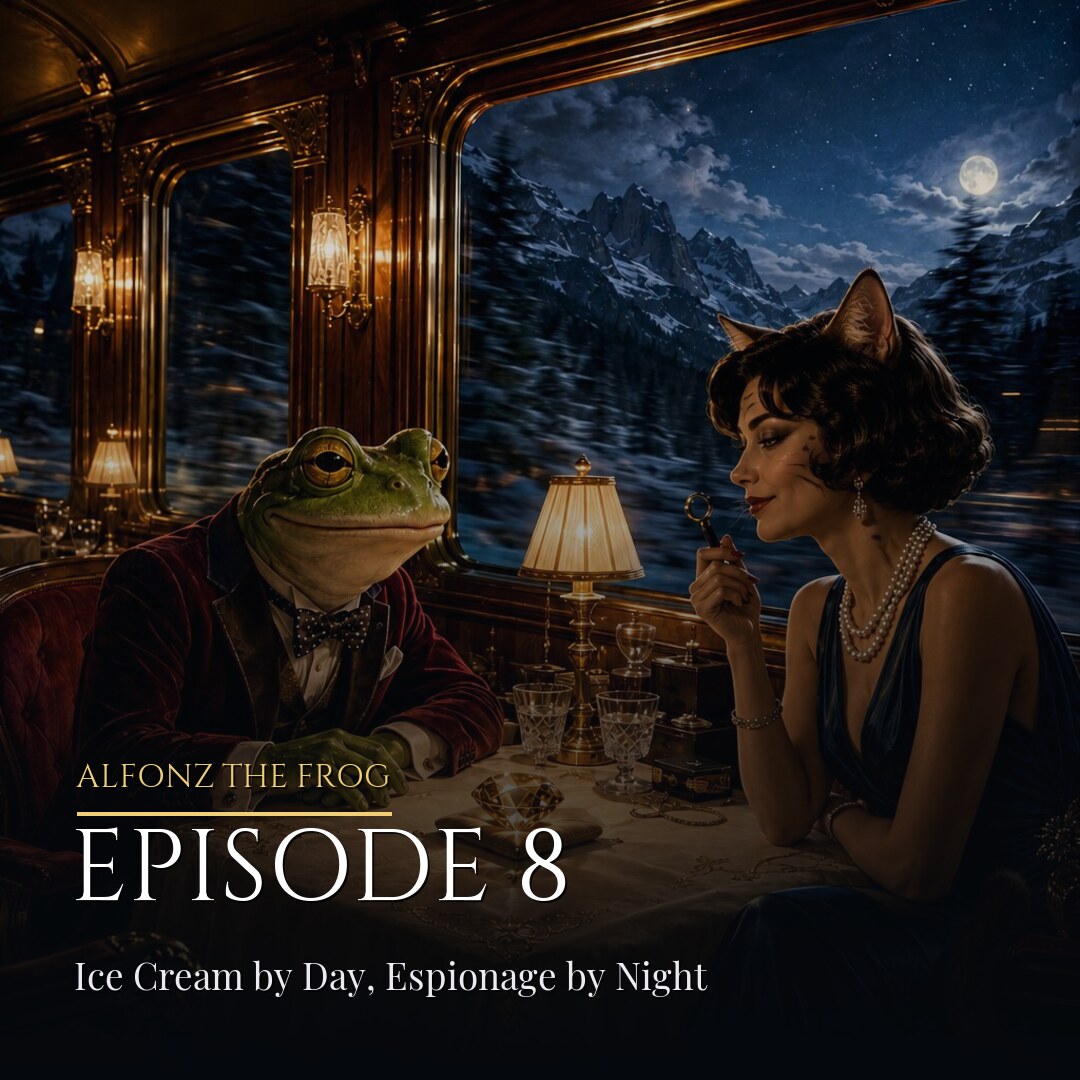
The Halcyon Express was a thing of brass and lamplight and slow curving speed, forty kilometers of glamour flung out along the dark. Alfonz found the players inside of an hour. The courier was a soft, damp man named Quill who kept a slim steel case chained to his wrist and flinched every time the train changed rhythm. Two of Prazan's people rode as escort, pretending to read. And somewhere up the line, at the end of it all, waited the recluse himself.
Alfonz drifted through the lounge car, admiring the marquetry, counting the exits without appearing to count anything at all. He was, he realized, enjoying himself. It had been a while.
Then he turned, and the woman by the window looked up from her glass, and every cheerful thing in him went very still.
She had cut her hair. She wore pearls and a gown the color of deep water and an expression of aristocratic boredom, and she was, unmistakably, the last person on earth who had shoved a cipher-drive into his hands and told him to run.
He recovered first, because he always recovered first. He crossed to her table and bowed the small bow of one traveler acknowledging another.
"Forgive me. I do not think we have met."
"Doctor Séraphine de la Croix-Valmont," she said, in an accent from no country that had ever existed.
"Doctor Séraphine de la Croix-Valmont," Alfonz repeated, tasting it.
"The Third," she corrected.
"Isn't that," said Alfonz, "a little over the top?"
"Says the frog calling himself Beaumarais-Lyon." She sipped her wine. "I read the passenger list, Alphonse. I nearly choked."
"You are the appraiser?"
"I authenticate the stone before the fool pays for it. It gives me a lovely excuse to hold it." Her eyes glittered, and for a moment the boredom was gone and the old wattage was back, and it was almost nice to see. "And you're the ice cream man on the train? Tell me you're not here for my diamond."
"I am not here for your diamond," said Alfonz, which was even true.
Neither of them believed the other, of course, so the next two hours were a small war conducted entirely in politeness.
She got to Quill's compartment first; Alfonz had already been and gone. He palmed a keycard from a steward; she had swapped it for a blank an hour earlier. They met again at the bar and toasted each other's failures. Somewhere past the mountains, both of them reaching at once for the same lock on the same case, they nearly collided in the dark of the baggage car and had to stand very close together, not breathing, while an escort walked past three feet away humming to himself.
"This is absurd," Scorpia whispered. "You'll blow it for both of us."
"I will blow it for one of us," Alfonz whispered back. "I have not decided which."
And then — because she was a professional, and professionals eventually stop wasting money — she said the thing that ended the war.
"What do you actually want, frog? Not the stone. You keep saying not the stone." She studied him. "You mean it."
"I want what is behind the setting," he admitted. "A sliver of tape no bigger than your fingernail. The rock I do not care about. The rock can go to your recluse and sit in a drawer for a hundred years."
She stared at him. Then she laughed — quietly, helplessly, a real laugh, the first honest sound she'd made all night.
"You want the crumb," she said, "and I want the plate."
"I want the crumb."
"Then why in the world are we fighting?"
They were not, it turned out, rivals. They were the two clean halves of one theft, and each of them had spent the evening trying to lose it.
The steal went the way the best ones go, which is quickly.
They took it in the small hours, on a long black curve where the train leaned and the escorts got sleepy. Scorpia walked into Quill's compartment as the doctor who had every right to examine the merchandise, and Quill, who had been dreaming of the moment he could hand the horrible responsibility to someone with a title, all but wept with relief as he unlocked the case.
The trouble came fast, the way trouble does — one of Prazan's readers was not as sleepy as advertised, and a gun came up, and the polite evening was suddenly over.
What the reader saw, in the half-second he had to see anything, was this: a small green gentleman coming through the compartment door not by walking but by leaping, a flat twenty-foot arc down the length of the car, and a tongue — eighteen inches of it — flicking the pistol clean out of his hand and into the dark. After that he mostly saw the ceiling.
They went out the back as the train screamed into a tunnel, Alfonz on the roof and Scorpia below, moving in the old wordless rhythm they'd found once in a colder vault, except this time nobody betrayed anybody. He took the second escort off the coupling with a grappling scoop that had ruined a great many evenings over the years. She had the case open before he was even down.
The Sazerac came out into the moonlight from the tunnel's end, and it was, he had to admit, a genuinely beautiful thing — warm and gold and unbothered, worth a war all by itself.
Scorpia held it up, and looked at him over the top of it, and for one long heartbeat the whole night balanced on a knife, because he had been here before, and so had she.
"You're waiting for it," she said.
"I am waiting for it," Alfonz agreed.
She popped the setting with a thin steel tool, caught the sliver of tape as it fell, and dropped it into his open palm.
"There's your crumb," she said. "Every word of it straight, this time. I find I don't enjoy owing you." She was already at the door, the Sazerac vanishing somewhere into the deep water of the gown. "The next station's yours. You're better at doors than I am — you always were."
"Scorpia."
She paused, half into the rushing dark.
"Save me a scoop, little frog," she said, and stepped off the Halcyon Express into the night, and was gone before the platform lights even found her.
"Package secured," Alfonz told Handler from the empty platform, the sliver warm in his fist. "The defector's list is coming home. The stone walked. Nobody died, Handler. Nobody even bled, except a little."
"And Scorpia?"
"In the wind. She let me have the crumb and kept the plate." He watched the last red lamp of the train shrink down the line. "She'll be back. She left owing me one less than she did yesterday, which for her is practically affection."
There was a pause on the line, and when Handler spoke again there was something careful in it, the way you say a thing you're not sure is allowed.
"You sound like yourself."
"Do I?"
"You had fun."
Alfonz considered the accusation, and found he could not honestly deny it.
"A man is allowed," he said, "one good night. Even a frog." He put the sliver away. "Especially a frog."
At ten the next morning the sun over Riverside was an honest gold, and the children came running, and Emma was first, up on her toes.
"You were gone yesterday," she said, faintly accusing.
"Business, chérie. I took a very long train ride." He built the cone, the second scoop finding its familiar wobble. "The road was a little rocky. But the company improved."
"Did you slip on the sprinkles again?"
He touched the small bruise on his shin, where a coupling had caught him somewhere past the mountains, and gave her his widest and most reassuring frog smile.
"On a train, this time," he said gravely. "You would not believe how many sprinkles they spill on a train. It is a scandal."
Emma giggled and took her cone and ran off across the grass into the light — the warm, loud, ordinary light of a street that would miss him — and Alfonz cranked the jingle, and tied his bow tie a little straighter, and did not, this time, count a single car on the block.
Both jobs. Same as ever. And the mint chip, he thought, watching her go, was holding beautifully.
« All episodes