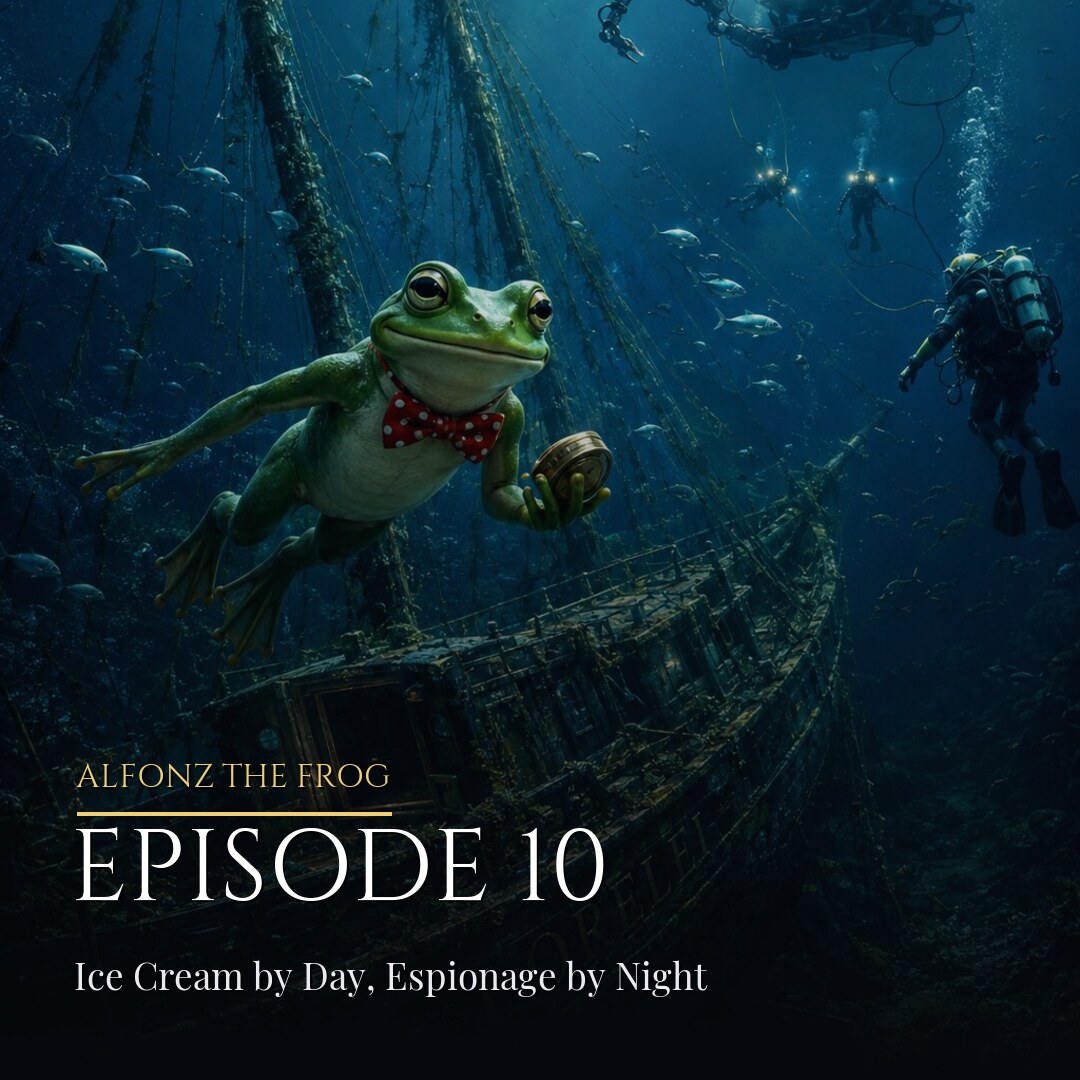
#10 · Saltwater Sorbet
September 17, 2026
At ten in the morning the sun over Riverside was the usual honest gold, and Alfonz was cranking his tinny "Entertainer," and Emma Rodriguez was first at the window, the way she was always first.
"Two scoops of mint chip," she announced. "And Mrs. Fenwick says it's going to hit 90°F today, so you should sell more."
"Mrs. Fenwick has the soul of a businesswoman," said Alfonz, and built the cone, the second scoop wobbling just so. "I will send her a commission."
She ran off across the grass, and his earpiece came alive, low and dry.
"Ribbit-7. Morning report." Handler. "The route's quiet. And our patient friend in the cold room — he moved."
Alfonz did not let his hands change what they were doing. "Moved how?"
"Nothing loud. Nothing I can prove. But someone spent last week making quiet inquiries about a green caterer — old agency rolls, a booking here, a health inspection there. Careful queries. Patient ones. None of it goes anywhere yet." A beat. "It has his handwriting on it. Vane's started looking."
"He has no money and no proof."
"He has time. He's decided to spend it learning the shape of your days, the way you learned the shape of his." Handler let that sit, then set it down for good. "He's nowhere near you. I'll tell you the second that changes. In the meantime — I have something that will irritate you, because you're going to enjoy it."
"You always say that."
"This one's wet."
She told him about the Lorelei — a racing schooner, all brass and varnish and speed, lost in a storm off the Ionian coast a very long time ago and written off as gone. A survey ship had pinned her on the seabed the month before, seventy meters down, both masts still standing. And a man named Magnus Brine had gotten there first.
"Salvage," said Alfonz.
"Salvage as theater. He does it with sponsors and a documentary crew and a submersible that cost more than a small navy. Right now he's promising nine hundred thousand subscribers he's about to raise a legend." Her voice cooled a degree. "What he hasn't told them is what went down with her. A diplomat rode the Lorelei on her last night, and he'd just filmed a meeting that officially never happened. The reel went into a waterproof case in his cabin, and the case went to the bottom with everyone aboard."
"And you would like the film before Mr. Brine sells it to someone who collects other people's meetings."
"I would like exactly that. You get down, you find the canister, you leave the wreck for his cameras. Nobody dies. Nobody gets wet who doesn't want to be." A pause. "Simple retrieval."
"One day," said Alfonz, "you will say that and be right, and I will faint into the sprinkles."
He flew out that night, and by the next afternoon he was riding a warm green sea under a sky with no weather in it, which was the best news his body had heard in weeks.
He came aboard Brine's support ship as a marine naturalist, and it was the most comfortable cover he had ever worn, because for once he did not have to explain himself. A film crew that had flown a submersible to the middle of the sea would of course retain a consultant on the local fauna, and if the consultant happened to be three feet tall and green and spent an unusual amount of time in the water — well, that was rather the point of hiring him.
"You'll want to mind the currents, Professor," the dive master told him, kindly, on the first morning. "It's a serious depth. We lose people who don't respect it."
"I respect it enormously," said Alfonz, who did.
He spent the morning watching them work, and what he watched was a war against the sea fought entirely with machinery. Brine's divers went down in mixed-gas rigs that bought them a few careful minutes on the bottom and charged an hour of decompression for the privilege. The submersible — christened, without irony, the Pearl — went down on a cable with its lights blazing and its robotic arm folded up like a mantis. Every soul on that ship was counting something. Gas. Minutes. Meters. Money. The sea let them visit, and it did not let them stay.
Magnus Brine held court on the afterdeck, tanned the color of a good saddle, in a linen shirt he had somehow never sweated through. He was handsome in the expensive way, and he narrated everything, because a camera was always somewhere near. "The sea keeps her secrets," he told a lens, gazing nobly at nothing. "But she has never met me."
Alfonz, passing with a clipboard, decided he could work with a man like that. Vanity was a door that only ever opened outward.
Brine's pride, after the submersible, was a matched pair of champion free-divers he flew everywhere with. Doria was a lean, silent woman who could touch the bottom on a single breath. Andrea was a lean, silent woman who could do it a little deeper. Between them they made the mixed-gas crew look overdressed.
"Andrea and Doria," the dive master said, presenting them with some pride. "Best in the world. Stay out of their way, Professor, and you'll keep all your fingers."
"Andrea," Alfonz repeated slowly. "And Doria." Something crossed the small green face and did not quite finish becoming a smile. "The irony is —" He caught himself. "Never mind."
The dive master waited, and when nothing came he wandered off to be useful, and Alfonz went back to his clipboard and the serious business of looking like a man who cared about fish, privately delighted with a joke he would have to keep, like so much else, entirely to himself.
He went down that night, when the cameras were charging and the divers were sleeping off their nitrogen.
He went the way he had gone off Pier 19 a lifetime ago and had not truly gone since — alone, unhurried, with nothing on his back and nothing to breathe for a good long while. He slipped off the dark side of the ship, and the sea took him, and the sea took him gladly.
There was no equipment to fail. There was no clock. The pressure that folded steel suits closed around him like a hand he had shaken a thousand times, and his eyes cleared behind their membranes, and the dark stopped being dark. He did not swim so much as remember how. Down through the warm upper water, and then the cool beneath it — a coolness at thirty meters that would have been the first note of Budapest's old song if he had let it be, and he did not let it be, because tonight the water was not his enemy and the cold was only weather.
The Lorelei rose out of the blue-black beneath him, and he stopped, and for a moment he only looked.
She stood upright on the sand as though she had merely anchored for the night. Her two masts climbed into the dark, her rigging gone soft and green and swaying, hung with the slow silver of fish. A schooner asleep. Whatever storm had taken her had been gentle about it, or the sea had been gentle since. Alfonz drifted down her length, past the wheel, past a companionway open like a held door, and felt a thing he did not often feel on a job, which was welcome.
He went in through the companionway, into the dark below, where a hard suit could not fit and the Pearl could not follow. The diplomat's cabin was aft, the intel had said, and the intel for once was close. He found the small cabin, and the small desk, and the small drawer that had held a waterproof case for a very long time.
The drawer was open. The case was gone.
He hung in the dead man's cabin and did the arithmetic. A waterproof case does not float off, and it does not swim. It had gone down — slid, when the old ship finally settled, through a broken deck into the crushed dark of her belly, where the silt was deep and the fallen rigging lay in nets. He could feel where it must be, the way he always felt where the water was. It was in the one part of the wreck no diver would ever reach.
Which meant Magnus Brine had a problem, and did not yet know Alfonz was about to have the same one.
"My divers say there's a frog on my wreck," Brine announced the next morning, delighted, a camera drinking him in. "A frog! At seventy meters! Professor, you're the naturalist — tell me they've been narced."
"It is possible," said Alfonz gravely. "The deep does strange things to the mind. I once saw a man convinced he had found a legend, when it was only a very old boat."
Brine laughed, because he had not yet understood he had been insulted, and put a warm heavy arm around the small green shoulders and steered him to the rail, out where the wind took his voice from the microphones.
"Between us." The smile did not move. "They also say the cabin's empty. Which is a shame, Professor, because the reel is the whole reason I'm out here, and the reel has gone into the belly of that ship where I can't send a suit and I can't send the Pearl." He looked out at the flat bright water. "So tomorrow, on camera, I raise a legend. Which is a lovely way of saying I open her up like a tin of fish and take what's inside, and my subscribers weep, and my buyer pays on Thursday." He patted the shoulders, twice, friendly as a warning. "Nobody sends a nature program to the bottom of the sea. I don't know whose you are. But you're on my ship now. And I don't lose on camera."
"No," Alfonz agreed. "I imagine that would be terrible for the brand."
He went that night, ahead of the morning's butchery.
The belly of the Lorelei did not want him, and that was fair, because it did not want anyone. He went in through the break in her deck, down into a crushed dark where the water lay dead and thick with silt and the fallen rigging hung across everything like the web of a very patient spider. Here, at last, the sea asked something of him. The space closed to the width of his shoulders. The cold sat heavier in the still water, a slow honeyed weight at the edges of his legs, and he moved before it could become an opinion. A curtain of old cordage snagged his arm in the dark, and for one bad second the belly of the ship held him the way a closing drawer holds a hand — and then his tongue found the taut line above the snag, and pulled, and eighteen inches of muscle did in an instant what a knife would have fumbled for a minute.
The case was where the water said it would be, wedged nose-down in the silt beneath a fallen beam, and he worked it free and held it, and it was small and cold and absurd, a dead man's home movie that two governments and a showman all wanted enough to gut a ghost for. He tucked it against his chest and let the wreck give him back to the open water, up out of her belly, up her swaying green rigging, up into the warm and the light.
Brine opened the Lorelei the next morning, on camera, with tears in his eyes and a crane and the Pearl's bright cruel tools, and it made, everyone agreed, extraordinary television.
The cabin, when they reached it, held a great deal of silt and a dead man's empty drawer, and nothing else at all.
Alfonz was at the rail with his clipboard when Brine came looking for him, and he watched the exact moment the man understood — watched the salvor run the same sum he himself had run in the dark two nights before, and reach the same impossible answer, and, being at heart a professional, arrive at delight.
"It was you." Brine said it quietly, wonderingly, out where the microphones could not reach. "You went into the belly. On one breath, in the dark, where I sent a two-million-dollar submarine and it wouldn't fit." He shook his head slowly. "A frog. All that gear, and the sea just — handed it to the one thing on my ship that belonged to her." He almost smiled. "Who are you?"
"Someone the water knows," said Alfonz. "You should not feel badly, Monsieur Brine. You fought the sea very expensively. It is only that I did not fight her at all."
"My buyer is going to be extremely disappointed on Thursday."
"Your buyer," said Alfonz, "is going to have a different visitor entirely. I would not be there when he arrives." He set down the clipboard. "You may keep the legend. You raised her; she is yours, and she photographs beautifully. Only the home movie was ever ours."
Down the rail, Andrea and Doria caught his eye, and held it a moment, and gave him the smallest nod one deep creature gives another — the only two on that whole loud ship who had known, all along, exactly what they had seen at seventy meters in the dark. Alfonz tipped an imaginary bow tie to them, and went to pack.
"Package secured," he told Handler from the shade of the catering awning, the canister cool in its sleeve. "The film is coming home. The wreck stays with the cameras. And nobody died, Handler. Nobody even got wet who didn't want to be."
"And Brine?"
"In love with his own footage, and about to be very useful to whoever meets his buyer on Thursday." He watched the flat blue water. "He took it well. The good ones always do."
"Right up until they don't." A pause, and something almost warm in it. "That's three, Ribbit-7. Three easy ones. I'm beginning to think you've forgotten how to have a hard day."
"I remember," said Alfonz. "I am simply choosing not to, for a little while longer."
At ten the next morning the sun over Riverside was ordinary and gold, and Emma was first at the window.
"You were gone again," she said, faintly accusing.
"Business, chérie. A boat this time. A very old one." He built the cone, the second scoop finding its familiar wobble. "I spent the whole week in the water. It was, I think, the happiest I have been in a long while."
She squinted at a thin red line along the side of his hand, where old cordage had caught him a lifetime and two nights ago. "Did you slip on the sprinkles again?"
"On a boat," Alfonz said gravely, "you would not believe the trouble. The sea rocks, and the sprinkles roll from one end to the other, and a man cannot take a single step without an adventure. It is a scandal."
Emma giggled and took her cone and ran off across the grass into the light — the warm, loud, ordinary light of a street that would miss him — and Alfonz cranked the jingle, and tied his bow tie a little straighter, and did not, this time, count a single car on the block.
Both jobs. Same as ever. And the mint chip, he thought, watching her go, was holding beautifully in the heat.
Somewhere on the other side of the world, in a room kept carefully cold, a patient man was reading old catering rolls by lamplight, learning the shape of a green man's ordinary days — and that was a problem for a Tuesday that had not yet come.
Today the sun was warm, and the sea was a week behind him, and Alfonz had a streak going.
« All episodes