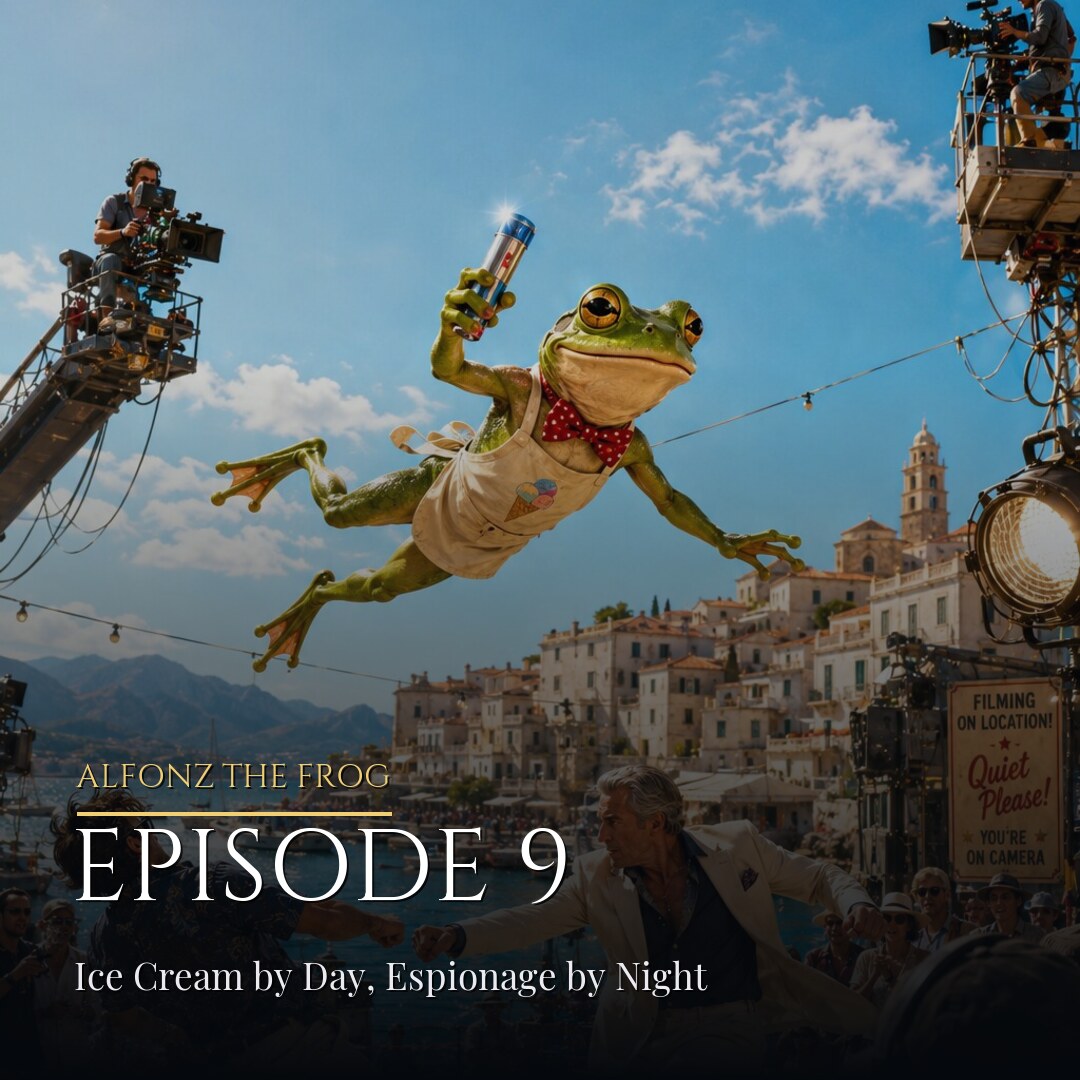
#9 · Sundae Matinee
September 10, 2026
At ten in the morning the sun over Riverside was the usual honest gold, and Alfonz was cranking his tinny "Entertainer," and Emma Rodriguez was first at the window, as she was always first.
"Two scoops of mint chip," she said, "and Mrs. Fenwick says there's a MOVIE. A real one. With a movie star."
"So I hear, chérie." He built the cone, the second scoop wobbling just so. "In fact, I am told they need a man of refined frozen talents. I may go and cater."
"You're going to be in a MOVIE?"
"I am going to be near a movie," Alfonz corrected, "handing it ice cream. It is not quite the same thing." He passed the cone down. "Though I have, in my time, been mistaken for a great many things."
Emma took her cone and ran, and his earpiece clicked on.
"Ribbit-7." Handler, dry as ever. "I want you to know this one is beneath you, and I'm giving it to you anyway, because it's small and sunny and nobody dies."
"You spoil me."
"There's a film shooting on the Dalmatian coast — a spy picture, the fourth of its kind, called The Cortez Protocol. Enormous budget, enormous star, enormous prop. The plot turns on a device the fictional villains want, and the prop department built a beautiful fake of it. A consultant on the production, one Victor Sable, has swapped a real one into its place."
"Real how?"
"Real enough that a certain government would like it back, and real enough that Sable means to walk it out of the country the one way nothing ever gets searched — packed in a film crew's crates as set dressing. Customs waves a movie through. They always do." Her voice warmed a half-degree. "You get on the set, find the real one among the fakes, swap it back, and the production ships home a harmless prop none the wiser. Sable is ex-trade — good, vain, careful. Don't let the sunshine fool you."
"A consultant," said Alfonz, pleased despite himself. "They hired a spy to make the spies look real."
"They did. And now a real one is going to make him look foolish. Wheels up tonight. And Ribbit-7 — the leading man requested a specific ice cream artisan. It's in his contract. Congratulations, you're it."
The coast was all white stone and blue water and a sun that lay warm across everything, and for two hundred meters along the old harbor the twenty-first century had been dressed up as somewhere that had never existed. Cables ran like vines. Men shouted numbers. A fake café had been built beside a real one, and it was, Alfonz noted, the better café.
He came aboard as the artisan the star had demanded, wheeling a gleaming cart of frozen things through a small green haze of self-satisfaction, and nobody looked at him twice — because on a film set, a small green gentleman in a bow tie is not the strangest thing to walk past before lunch.
There was a private joke in it he could not quite put down. Years ago, on a very different waterfront, he had convinced a bewildered dockworker that the violence he'd witnessed was only a movie being filmed. And here he was now, inside the movie, the safest place a man in his line of work could possibly stand — because on a set, the truth and the performance of the truth are shot on the same camera, and no one can tell them apart.
The star was Rex Steele, who played the spy and could not open a door without a stunt coordinator. He was six feet of jaw and hairspray and a genuine terror of everything, and he had one comfort in the world, and it arrived on Alfonz's cart.
"There he is," Rex breathed the first time, cradling the cone like a relic. "There's my guy. Nobody touches my ice cream but this guy." He aimed a trembling, manicured finger. "You're the only real thing on this whole set."
"You have no idea," said Alfonz.
The director was Lena Brandt, who had begun the shoot an artist and would end it a survivor, and who now communicated exclusively in the language of a woman two days behind schedule. And moving easy through all of it, clipboard in hand, murmuring authentic little corrections into everyone's ear — hold the pistol lower, a real agent stands so — was Victor Sable.
He was very good. Alfonz watched him teach a stuntman to fall like a man who has actually been shot, and thought: yes. You would know.
The device sat on a velvet cradle under a small guarded tent, because Lena believed in treating the prop like a star and the star like a prop, which was the only sensible arrangement anyone had made all week. It was a lovely thing — a sleek core of brushed steel and blue glass, the sort of object that means nothing and photographs like the end of the world.
There were, Alfonz established by the second day, two of them.
This is the trouble with hiding on a film set: everything you do to look like you belong makes you look like you're working, and everything secret looks like a scene.
He climbed a rigging tower to study the prop tent from above, and a grip gave him a thumbs-up for his commitment. He picked the lock on the props trailer at two in the morning, and a passing electrician assumed he was "in character." When a guard nearly caught him easing the tent flap, Alfonz simply froze in a dramatic crouch, and the guard waited politely for someone to yell cut.
"Is that in the script?" a runner asked, watching him scale a wall.
"Improvised," said Alfonz, from the top of the wall.
"It's incredible. Who's your coordinator?"
The only real obstacle was Rex, who had a gift for needing mint chip at the precise moment the caper required both of Alfonz's hands. Twice he was three seconds from the real core when a plaintive "ICE CREAM GUY" rolled across the set and he had to become, once more, a man whose only job was dessert.
The two cores were identical to the eye, and that nearly worked on him. But the fake had been built to be beautiful, and the real one had been built to work, and a thing built to work is always a little heavier than a thing built to be seen. He found the tell on the third night, weighing one and then the other in his webbed hands in the dark.
He also, turning, found Victor Sable watching him from the tent flap.
Neither of them reached for anything. That wasn't how this worked. Not here, not yet.
"The ice cream is genuinely good," Sable said. "I had some. I wondered how a caterer moved the way you move." He tilted his head, and there was no fear in him at all, only a professional's slow, delighted recognition. "You're not with them. You're with somebody quieter, and they sent you for my little swap." A smile. "They sent a frog."
"They sent the man who was already on the guest list," said Alfonz. "You should be flattered. It means you're expensive."
"Wrap is tomorrow. The crates go to the airport at noon." Sable stepped back into the light, a man holding four aces. "There's a guard on the tent, a scene on the schedule, and a very jealous movie star between you and my core. You've lost, and you're too good not to know it."
"You're probably right," Alfonz agreed. "Cone?"
The climactic sequence filmed at noon the next day, which was, Alfonz thought, obliging of everyone.
It was the big one — the harbor chase, Rex Steele fleeing across the rooftops and the moored boats with the fictional device in a fictional briefcase, cameras up on three cranes, half the town watching from behind the tape. Lena had one shot at the light. Every soul on that production was pointed in exactly one direction.
Which meant nobody was pointed at the prop tent.
Nobody except Sable, who had stationed himself beside it, calm and certain of his afternoon — and who had made the one professional's error of assuming the frog would come to the core.
The frog went to the take.
What the cameras caught, and what the town applauded, and what would eventually screen in nine hundred theaters to the great confusion of everyone who worked on it, was this: as Rex Steele scrambled heroically along the harbor wall, a second figure entered frame — small, green, impossibly fast — and the fight that followed was so much better than anything in the script that Lena Brandt did not, could not, would not call cut.
Alfonz took Sable across forty meters of rooftop and moored boats, and it looked like choreography. He leaped a gap no wire could sell — twenty feet of clean air — and a camera operator wept openly. His tongue flicked the real core off Sable's belt in a blur the effects house would later swear it had added, and Sable's snarl of pure professional fury became, in the finished film, one of the more convincing performances in it.
They ended at the water's edge, the frog and the consultant, the real core warm in Alfonz's palm, and Sable understood — Alfonz watched him understand — that the tent behind him was empty and always had been. The man had never gone for the core, because the man had made the core come to him.
"You didn't guard the prop," Alfonz said. "You guarded the wrong place. Everyone was looking at the movie." He shrugged. "So was I. I just knew it was one."
"AND CUT!" Lena Brandt was on her feet with tears in her eyes and the whole crew already applauding. "That's the ONE. That's — who was that? Somebody get me that little guy, we are nominating that little guy —"
Two quiet men in production polos, who had joined the crew that morning and would leave with it that afternoon, helped Mr. Sable up from the water and walked him, unhurried, to a waiting car, and everyone assumed it was a wrap thing.
"That's a wrap on Mr. Sable," someone called. And it was.
"Package secured," Alfonz said from the shade behind the catering truck, the real core cooling in an insulated sleeve. "The prop stays with the movie. Sable's yours. And Handler — he knows a frog took him. He seemed almost happy about it."
"They usually are, the good ones. Right up until they aren't." A pause. "Two easy ones in a row, Ribbit-7. People will talk."
"Let them," said Alfonz. "I am on a streak."
At ten the next morning the sun over Riverside was ordinary and gold, and Emma was first at the window.
"You're back! Were you in the movie? Did you meet the star?"
"I met the star. He was very frightened of doors." He handed the cone down, the second scoop wobbling just so. "And I did a little of everything, chérie. Even, once, some catering."
She squinted at a scrape along his knuckle. "Did you slip on the sprinkles again?"
"On a film set," Alfonz said gravely, "they employ people whose entire job is to make things fall over. It is a very dangerous place for a man who likes ice cream."
Emma giggled and ran off across the grass into the light, and Alfonz cranked the jingle, and did not count a single car, because it was summer, and he had a streak going.
It was some weeks later that she came tearing across the grass ahead of the whole after-camp crowd, a phone held up in one small triumphant fist.
"MR. ALFONZ. Mr. Alfonz, it's YOU."
On the little screen a trailer played — THE CORTEZ PROTOCOL, a wall of explosions and Rex Steele's jaw — and there, for half a second, small and green and airborne over a harbor in a leap no person alive could make, was a figure the internet had already decided must be "the best CGI of the year."
"That's my ice cream man," Emma announced to the neighborhood.
Alfonz leaned down and considered the tiny leaping green figure with the air of a connoisseur.
"You know, chérie," he said, "I think that fellow is a little too good to be real." He tipped the second scoop into its wobble and handed it down. "It is probably done with computers. They can do anything now."
Emma decided this was the funniest thing she had ever heard, though she couldn't have said why, and ran off into the sunlight to tell everyone that her ice cream man was a movie star — which was not true, and which was also, in every way that mattered, exactly correct.
« All episodes