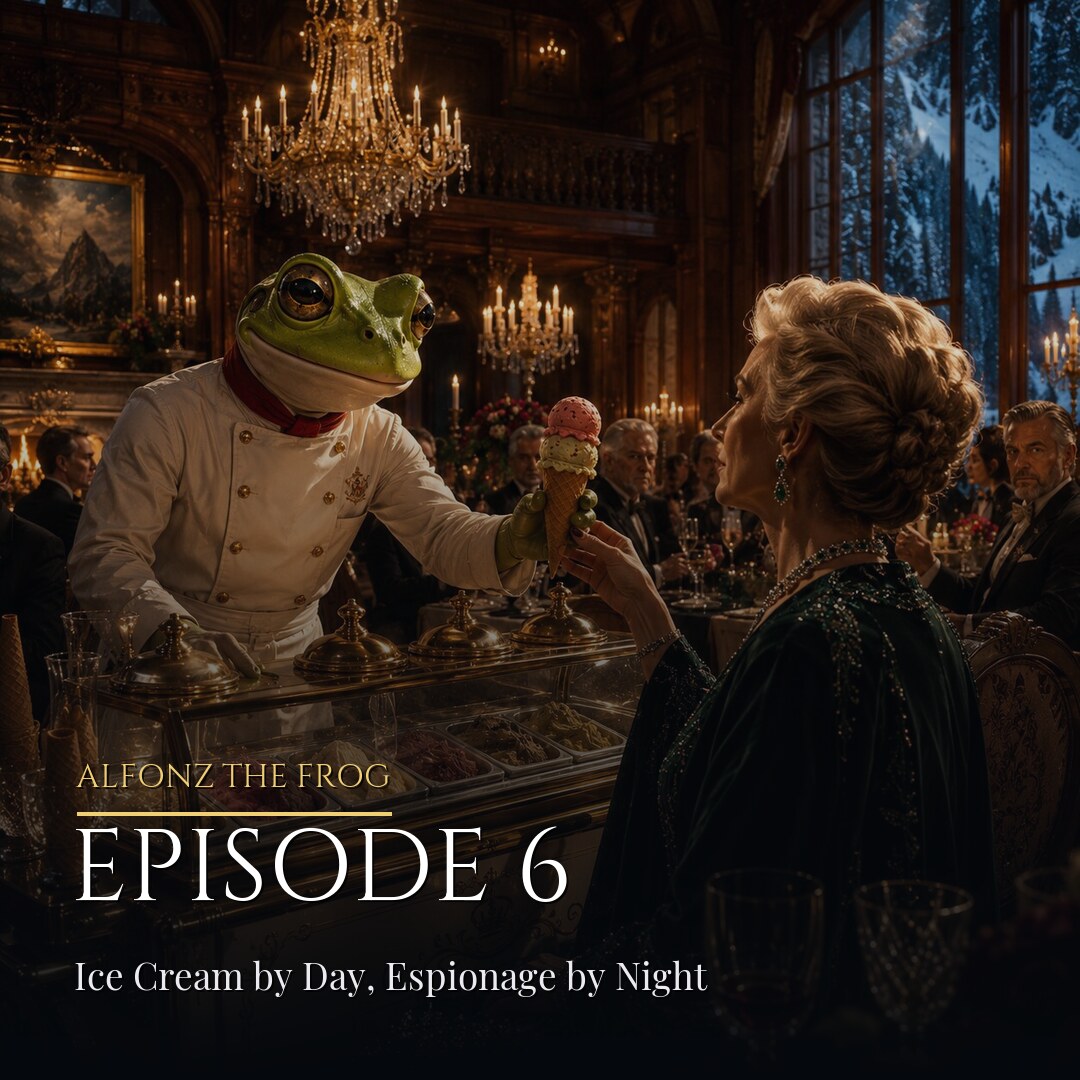
#6 · The Double Dip Double Cross
August 20, 2026
For years, Alfonz had waited. He had grown rather good at it—at standing in warm places, at being found. He had never once, in all that time, sent Nightshade a bill of his own.
He decided, on a Tuesday, to change that.
"You want to attack a market," Handler said, in the tone of a woman confirming she'd heard a frog volunteer to punch the ocean.
"I want to attack a feeling." Alfonz spread the file across the fold-down table in the back of the truck, and there was something new in the set of his shoulders, something that hadn't been there before the Argentum. For years he'd been on the back foot—the retriever, the escaper, the one who arrived second. He was tired of arriving second. "A market is not a building I can blow up, you taught me that. It has no head to cut off. But it does have one thing it cannot survive without, and it is the softest, most expensive thing in the world." He tapped a photograph. "It has to trust itself."
The photograph was of a genial, silver-haired man in a beautiful suit, laughing at someone's joke.
"Auguste Vane," Handler said. "The Honest Broker."
"Forty years in the trade and he has never once broken a confidence. That is his entire product—not muscle, not money. Trust. When two people who would happily murder each other need to do a deal, they route it through Vane, because Vane's word is the only thing on earth they both believe. He is the clearing-house. He is the handshake the whole invisible hand shakes with." Alfonz sat back. "So I am going to make them believe he sold them out."
"He's not innocent," Handler said. It wasn't a question, but Alfonz answered it anyway.
"No. He clears the deals that end cities. He knows exactly what he greases, and he sleeps beautifully. He is guilty of everything except the one thing I'm going to hang him with." Alfonz almost smiled, and didn't quite. "They think I'm the leak in their ledger. I'm going to introduce them to a better suspect."
He did the route one more time before he left, because he always did.
"Two scoops of mint chip," Emma announced, "and you've got a face like you're about to do something."
"I am always about to do something, chérie. It is the nature of business." He handed the cone down, the second scoop wobbling. But he held the moment a beat longer than usual, the sun and the grass and the small sticky miracle of her, because the thing he was about to go and do was a cold thing, colder than a rescue or a theft, and he wanted to feel the warmth first, for once.
"You're being weird," Emma diagnosed.
"I will be less weird on Thursday," Alfonz promised, and by Thursday he was three thousand kilometers away, wearing a chef's whites and an accent even thicker than usual, wheeling a gleaming ice-cream cart into the most dangerous room in the world.
The Armistice was a palace pretending to be a hunting lodge, high in the pines where three borders blurred together and no country's writ quite ran. It was neutral ground—the one place the principals of the invisible hand could gather in the flesh without any of them ending the evening in a lake, because the peace of the Armistice was personally guaranteed by the man who owned it, and his guarantee had never failed.
They had hired an artisan for the summit's dessert service, a temperamental genius of frozen cream flown in at absurd expense, and if the temperamental genius happened to be green and roughly three feet tall, well, the very rich have always collected eccentricities.
"You will make them something impossible," said the maître d'.
"Monsieur," said Alfonz, wounded, "I make nothing else."
He made them impossible things. He made a saffron cardamom that a Bulgarian arms-widow wept into her napkin over. He made a smoked-vanilla double-dip that a man who had personally engineered two famines pronounced "the finest thing in this house," which Alfonz accepted as the darkest compliment of his career. He rolled his cart from table to table through a room full of the most careful people alive, and he served them cold sweet things with a flourish, and he watched, and he counted, and under the false floor of the cart—beneath the dry ice and the good vanilla—a single cold cipher-drive waited to ruin the evening.
And at the center of it all, moving easy through the sharks like the only warm-blooded thing in the tank, was Auguste Vane.
He was better than his photographs. He remembered every name, every grievance, every daughter's wedding. He put his hand on a shoulder here and murmured there and a deal that had been frozen for a year quietly thawed, on nothing—on nothing—but the fact that Auguste Vane had said, softly, you can trust him, I'll vouch for it. Alfonz watched a hundred million change hands on the strength of one man's word, and understood, with a clarity that was almost admiration, exactly how much would break if that word ever cracked.
"You're new," Vane said, appearing at the cart, warm and unhurried.
For one bad second Alfonz's whole spine went to ice. Then he did what he always did, which was to become more of himself. "I am not new, monsieur. I am discovered. There is a difference, and it is roughly forty years and a great deal of suffering."
Vane laughed, delighted. "A single scoop, then, from the discovered genius. Whatever you'd give a man who's forgotten what surprises taste like."
Alfonz gave him the smoked vanilla, and Vane ate it standing there, eyes half-closed, and said, "God. Where have you been hiding?" and Alfonz, who was in the middle of destroying him, felt the cold thing in his chest turn over just once, and served the next table.
The trouble with the very careful is that they have already imagined every betrayal. You do not have to convince them the ceiling might fall. You have only to hand them the crack, and let them look up.
They were already frightened. Somewhere out there was a hole in their ledger—someone had reached into the Argentum and taken a piece of the books, and for months they had been hunting the leak with a paranoia that had no bottom, because a market that cannot keep its own secrets is already dead and simply hasn't been told. They suspected a frog. They suspected each other. What they had never once suspected, because it was unthinkable, was the man who held all their secrets by trade.
Which was exactly why it would work.
Alfonz did not accuse Auguste Vane of anything. That was the whole art of it. He simply arranged, over two nights and with the help of a forgery Handler's people had built to be found, for the stolen ledger fragment to surface inside the Armistice bearing the one thing no other human being could have put on it: Vane's own clearing-seal, the private mark he pressed into every deal that passed through his hands. A fragment of the market's stolen books, sealed by the market's most trusted man. Proof, to a frightened room, that the leak had a face, and the face was the last one any of them would have chosen, which is precisely why the mind, once it sees it, cannot look away.
He didn't even hand it over. He let a suspicious lieutenant of the famine-man find it—in a place a guilty Vane might have hidden it, discovered by a paranoid mind that got to feel clever for the finding. A con is never so strong as when the mark believes he thought of it himself.
Then Alfonz served the dessert course, and waited for the ceiling to fall.
It fell without a single voice raised, which was the most frightening thing Alfonz had ever seen, and he had seen a great deal.
There was no shouting at the Armistice. There was only, over the course of one long candlelit dinner, a slow subtraction of warmth. A principal who did not laugh at Vane's joke. A deal that did not, after all, close tonight—"let's revisit." A pair of quiet men who had not been at the door before, and now were. Auguste Vane, forty years the calmest man in every room, watched his own guarantee curdle around him and could not understand why, and then—Alfonz saw the exact instant—began to understand that he could not stop it. His denials were perfect and true and worth absolutely nothing, because the terrible arithmetic of trust runs one way only: it takes a lifetime to build and one plausible night to end, and there is no court of appeal in a market, no evidence rules, no benefit of the doubt. There is only the price, and the price of Auguste Vane had just gone, in an evening, to zero.
By midnight the clearing-house of the invisible hand had stopped clearing. Deals that lived on his word were freezing all over the world, and men who had done business for decades were looking at one another and doing new sums, the ones that started with if he could be turned, anyone could, and the peace of the Armistice—the thing that let the sharks swim together—was quietly, permanently over.
Alfonz packed his cart. On his way out, wheeling past the ruin of a man sitting very still at an emptying table, he allowed himself one look, and Auguste Vane, who missed nothing, who had built forty years on missing nothing, looked up and met the eyes of the little green chef, and something moved behind his face—not accusation, not yet. A question. The first pull of a thread that a clever, ruined, patient man would spend a long time following.
"Enjoy the rest of your evening, monsieur," said Alfonz, and rolled his cart out into the cold pines, and did not look back, because he had learned that from a better man than himself.
"It worked," he told Handler, over the dark ocean, home-bound. "The hand is fighting itself. It'll be months before they trust anyone enough to end a city again."
"That's the biggest win anyone's landed on them in a decade," Handler said. "You should sound happier."
He watched the black water for a while.
"I made them afraid of a thing that wasn't true," he said finally. "I took a man—a guilty man, a terrible man, but a man—and I built him a betrayal he didn't commit, and I aimed a room full of monsters at him, and I did it with a forgery and a smile and a very good vanilla. That is their trick, Handler. Manufacturing a fear and selling it. Tonight I was extremely good at their trick."
The line was quiet a moment.
"Yes," Handler said. She did not tell him it was fine. He was grateful to her for that, more than he could say. "And tomorrow you'll go home and be extremely good at yours. That's the difference. It isn't that you can't do what they do. It's where you go afterward."
"Where I go afterward," Alfonz repeated.
"You go back to the ice cream, Ribbit-7. Go home."
At ten the next morning he was parked outside Riverside Elementary, and the sun was ordinary and gold, and he served two scoops of mint chip to a small girl who did not know and would never know that her ice cream man had, forty-eight hours earlier, quietly ended the peace of the invisible hand with a dessert cart.
"You're less weird today," Emma observed, approvingly.
"I told you I would be. It is Thursday, more or less." He handed the cone down, the second scoop wobbling just so, and the wobble of it, the sheer stupid sweetness of a thing that existed only to make a child happy, put something back in him that a candlelit dinner three thousand kilometers away had taken out.
"Did the business go okay?" Emma asked. "You said you were about to do something."
"I did the something," Alfonz said. "It was not a very nice something. But it needed doing, and now I am here, doing a much nicer one." He tapped the top scoop. "Two scoops is the nicer one, in case it was not clear."
Emma giggled and took her cone and ran off across the grass, and Alfonz watched her go, and let the warm ordinary day scrub the cold out of him, one scoop at a time.
Somewhere out past the pines, a market was learning to distrust itself, and would not soon forget the taste of it—and somewhere in the ruin of it, a patient man was beginning, very slowly, to pull a green thread. Those were problems for another Tuesday.
Today the sun was warm, and the mint chip was holding, and Alfonz had learned the last thing the invisible hand had to teach him: that he could do their trick, if he had to.
And that the whole trick of his life was making sure he never had to like it.
« All episodes